%22%20style%3D%22fill%3A%20rgb(5%2C%205%2C%205)%20!important%3B%22%3E%3Cpath%20d%3D%22M132.476%206.733h10.665V3.165h-15.008v15.614h15.008V15.21h-10.665v-2.495h9.834V9.148h-9.834V6.733m-12.78%2012.046H109.12V15.21h11.327v-2.406h-6.604c-3.302%200-5.111-1.647-5.111-4.658v-.315c0-3.011%201.809-4.658%205.111-4.658h9.744V6.74h-10.503v2.406h6.604c3.302%200%205.11%201.647%205.11%204.658v.315c0%203.012-1.808%204.659-5.11%204.659m-31.842%200h4.643l1.364-3.633h7.428l1.316%203.633h4.617l-5.933-15.614h-7.34l-6.087%2015.614zm10.35-12.046%201.76%204.844h-4.77l1.808-4.844zM86.62%208.945v.622h-4.351V6.733h-9.39v8.477h9.39v-2.745h4.351v.533c0%203.86-1.921%205.78-5.796%205.78h-6.491c-3.884%200-5.797-1.92-5.797-5.78v-4.06c0-3.86%201.921-5.781%205.797-5.781h6.515c3.859%200%205.78%201.921%205.78%205.78M61.971%2018.78%2067.3%203.165h-4.53L58.799%2015.21h-1.251L53.575%203.165h-4.618l5.328%2015.614h7.686M35.967%206.733h7.201v3.149h-7.201zM31.615%2018.78h4.352V13.45h6.442c3.302%200%205.11-1.647%205.11-4.658v-.96c0-3.012-1.808-4.66-5.11-4.66H31.615v15.615zM10.358%207.298h1.292V6.007h-1.292zm1.13-4.069h-.976v.977h.976zM11.335.452h-.662v.662h.662zm1.453%204.07h-.977v.976h.977zm-.161-2.778h-.662v.67h.662zM5.999%209.058H7.29V7.767H6zm-.356-2.793H4.505v1.138h1.138zM3.98%204.771h-.977v.977h.977zM2.325%203.27h-.823v.823h.823zM.67%201.768H0v.67h.67zm7.097%205.53h1.291V6.007H7.767zm-.364-2.793H6.265v1.138h1.138zM5.748%203.003h-.977v.977h.977zM4.093%201.502H3.27v.823h.823zM2.438%200h-.67v.662h.67zm6.62%208.59h1.292V7.298H9.058zm1.139-4.069H9.22v.977h.977zm-.154-2.777h-.67v.67h.67zM6%2011.65H7.29v-1.292H6zm-2.77-.162h.977v-.976H3.23zm-2.777-.153h.662v-.662H.452zM8.59%209.058H7.298v1.292H8.59zm-3.092.162h-.977v.977h.977zm-3.084.153h-.67v.662h.67zm2.107%203.415h.977v-.977h-.977zm-2.777-.161h.67v-.662h-.67zM22%200h-2.729l-6.33%206.33v.968H11.65V8.59h1.768v4.828H8.59V11.65H7.298v1.292H6.33L0%2019.272V22h2.729l6.33-6.33V22h3.883v-6.33l6.33%206.33H22v-2.729l-6.33-6.33H22V9.059h-6.33L22%202.728z%22%20style%3D%22fill%3A%20rgb(5%2C%205%2C%205)%20!important%3B%22%2F%3E%3C%2Fg%3E%3Cdefs%20style%3D%22fill%3A%20none%20!important%3B%22%3E%3CclipPath%20id%3D%22a%22%20style%3D%22fill%3A%20none%20!important%3B%22%3E%3Cpath%20fill%3D%22%23fff%22%20d%3D%22M0%200h143.133v22H0z%22%20style%3D%22fill%3A%20rgb(255%2C%20255%2C%20255)%20!important%3B%22%2F%3E%3C%2FclipPath%3E%3C%2Fdefs%3E%3C%2Fsvg%3E)
The structural frictions in the solar path to power
The majority of solar project failures—over 75%—occur in the pre-construction "Valley of Death" phase due to systemic technical gaps and structural friction points during technical due diligence and financing vetting, rather than during construction, with key risk stages including financing and feasibility (24%), permitting and grid interconnection (22%), and construction (14%), highlighting the need to address legacy workflow bottlenecks to improve project success and financial viability.


Solar projects don’t fail where you think they do
75% of solar project attrition is concentrated in the pre-construction "Valley of Death," driven by systemic technical gaps.
The solar project development process has reached a precarious technical threshold. Professionals across the industry — polled in a survey of over 400 specialists — report that project failures are caused by recurring structural friction points. Highlighting them is essential to clearing a path toward successful project delivery.
The failure timeline in the solar project development lifecycle
Projects do not fail at construction. They fail months earlier.
Over 75% of cumulative failure risk is concentrated in pre-construction — in the “Valley of Death,” during technical due diligence and financing vetting stages. This is the most volatile phase of a solar asset’s lifecycle.
Where the path to power breaks: stage-by-stage risk
24%
Financing & feasibility
22%
Permitting & grid interconnection
14%
Construction
Project failure is rarely the result of a single error; it is the compounding effect of a series of specific friction points that seal a project's fate. Best-case scenario, they lead to the solar workflow rework that compromises both internal rate of return (IRR) and long-term bankability.
The structural solar workflow bottlenecks of legacy development
The traditional path to delivery is hindered by solar energy project development issues that span the technical, structural, and financial layers of an organization. These encompass the five following friction pain points identified in our industry survey.
Disconnected tool stacks
Why 6.8 tools are 5.8 too many.
Every time project data moves between disconnected platforms, critical information is lost. "Copy-paste" engineering introduces multi-million dollar risks into the bankability of utility-scale portfolios.
Explore our research on solar project software fragmentation.
Lack of visibility for leaders
Managing portfolios in the dark.
When data is trapped in local CAD files and personal spreadsheets, leadership loses the ability to forecast accurately. This visibility gap makes it impossible to identify which projects are genuine assets and which are liabilities.
Find out of opaque solar workflows erode profitability.
Broken collaboration
The cost of siloed expertise.
Solar development is like a relay race — except handoffs are messy and the baton keeps getting dropped. When engineering, finance, and GIS don’t work off the same playbook, timelines slip, COD gets pushed, and teams lose time on avoidable rework.
See where and why collaboration between solar teams breaks.
Uncontrolled changes
The ripple effect of manual updates.
A single late-stage change in a module's specs shouldn't break a project. Yet, in fragmented workflows, one small adjustment triggers a wave of manual rework that compromises technical fidelity and schedule.
Learn more about the impact of unmanaged solar project version control.
General purpose limitations
Why Excel is not a solar design tool.
The industry’s reliance on non-specialized software creates a ceiling for growth. Generic tools lack the engineering-grade depth required to survive the scrutiny of modern solar investors.
See how general-purpose software in solar development leads to manual errors, delays and cost overruns.
Principles of project reliability
Pillar 1: Digital unification
Before a project can scale, the data must be centralized. This objective focuses on establishing a single source of truth where technical and commercial teams operate from the same live coordinates, eliminating the version chaos that kills IRR.
Pillar 2: Process standardization
Efficiency is a product of automation, not effort. By implementing automated workflows and native software integrations, developers remove the "manual glue" from their process, reclaiming senior engineering hours for value-added optimization.
Pillar 3: Predictive viability
Speed is secondary to certainty. A mature roadmap prioritizes early viability checks, using engineering-grade data at the prospecting stage to disqualify unviable sites in minutes rather than months.
Achieving reliability requires a shift in operational philosophy. By addressing the root causes of fragmentation, developers can move toward technical certainty through these core principles.
Moving beyond speculative design
The industry has spent decades perfecting individual tasks, yet the gaps between them remain the greatest threat to its momentum. Raising awareness of these friction points is a prerequisite for survival in an increasingly complex energy market.
To move past the era of fragmented legacy processes, developers must ensure that technical certainty and unified workflows are integrated into their plan to power.

Start de-risking your projects now
Cut solar development by 50% with seamless software integration.
.png/595d27af04467f11075f67b62ecd0792/amy-polvado-blog-image-(revised).webp) \
\
Podcast\
\
S1E12 | Power, planning, and the future of digital infrastructure, with Amy Polvado \
\
July 5, 2026
\
\
Podcast\
\
S1E12 | Power, planning, and the future of digital infrastructure, with Amy Polvado \
\
July 5, 2026 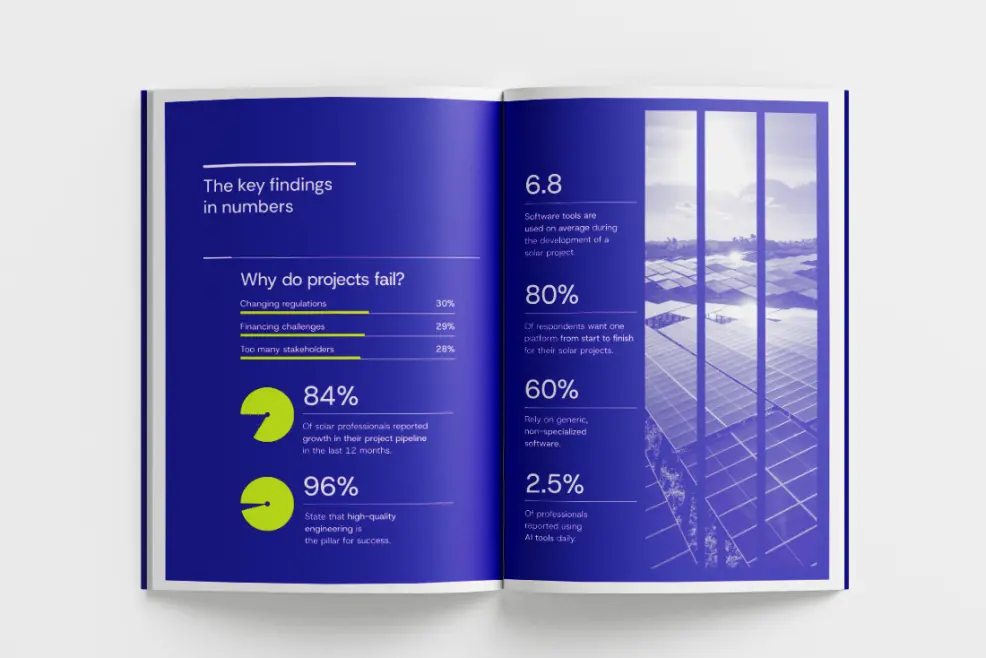 \
\
E-books\
\
The State of Solar Project Development Report \
\
September 30, 2025
\
\
E-books\
\
The State of Solar Project Development Report \
\
September 30, 2025  \
\
Webinars\
\
Maximizing solar outcomes with integrated workflows \
\
March 24, 2026
\
\
Webinars\
\
Maximizing solar outcomes with integrated workflows \
\
March 24, 2026
© 2026 PVcase
PRODUCT
SOLUTIONS
COMPARE
APPLICATIONS
RESOURCES
PRICING
COMPANY
© 2026 PVcase