%22%20style%3D%22fill%3A%20rgb(5%2C%205%2C%205)%20!important%3B%22%3E%3Cpath%20d%3D%22M132.476%206.733h10.665V3.165h-15.008v15.614h15.008V15.21h-10.665v-2.495h9.834V9.148h-9.834V6.733m-12.78%2012.046H109.12V15.21h11.327v-2.406h-6.604c-3.302%200-5.111-1.647-5.111-4.658v-.315c0-3.011%201.809-4.658%205.111-4.658h9.744V6.74h-10.503v2.406h6.604c3.302%200%205.11%201.647%205.11%204.658v.315c0%203.012-1.808%204.659-5.11%204.659m-31.842%200h4.643l1.364-3.633h7.428l1.316%203.633h4.617l-5.933-15.614h-7.34l-6.087%2015.614zm10.35-12.046%201.76%204.844h-4.77l1.808-4.844zM86.62%208.945v.622h-4.351V6.733h-9.39v8.477h9.39v-2.745h4.351v.533c0%203.86-1.921%205.78-5.796%205.78h-6.491c-3.884%200-5.797-1.92-5.797-5.78v-4.06c0-3.86%201.921-5.781%205.797-5.781h6.515c3.859%200%205.78%201.921%205.78%205.78M61.971%2018.78%2067.3%203.165h-4.53L58.799%2015.21h-1.251L53.575%203.165h-4.618l5.328%2015.614h7.686M35.967%206.733h7.201v3.149h-7.201zM31.615%2018.78h4.352V13.45h6.442c3.302%200%205.11-1.647%205.11-4.658v-.96c0-3.012-1.808-4.66-5.11-4.66H31.615v15.615zM10.358%207.298h1.292V6.007h-1.292zm1.13-4.069h-.976v.977h.976zM11.335.452h-.662v.662h.662zm1.453%204.07h-.977v.976h.977zm-.161-2.778h-.662v.67h.662zM5.999%209.058H7.29V7.767H6zm-.356-2.793H4.505v1.138h1.138zM3.98%204.771h-.977v.977h.977zM2.325%203.27h-.823v.823h.823zM.67%201.768H0v.67h.67zm7.097%205.53h1.291V6.007H7.767zm-.364-2.793H6.265v1.138h1.138zM5.748%203.003h-.977v.977h.977zM4.093%201.502H3.27v.823h.823zM2.438%200h-.67v.662h.67zm6.62%208.59h1.292V7.298H9.058zm1.139-4.069H9.22v.977h.977zm-.154-2.777h-.67v.67h.67zM6%2011.65H7.29v-1.292H6zm-2.77-.162h.977v-.976H3.23zm-2.777-.153h.662v-.662H.452zM8.59%209.058H7.298v1.292H8.59zm-3.092.162h-.977v.977h.977zm-3.084.153h-.67v.662h.67zm2.107%203.415h.977v-.977h-.977zm-2.777-.161h.67v-.662h-.67zM22%200h-2.729l-6.33%206.33v.968H11.65V8.59h1.768v4.828H8.59V11.65H7.298v1.292H6.33L0%2019.272V22h2.729l6.33-6.33V22h3.883v-6.33l6.33%206.33H22v-2.729l-6.33-6.33H22V9.059h-6.33L22%202.728z%22%20style%3D%22fill%3A%20rgb(5%2C%205%2C%205)%20!important%3B%22%2F%3E%3C%2Fg%3E%3Cdefs%20style%3D%22fill%3A%20none%20!important%3B%22%3E%3CclipPath%20id%3D%22a%22%20style%3D%22fill%3A%20none%20!important%3B%22%3E%3Cpath%20fill%3D%22%23fff%22%20d%3D%22M0%200h143.133v22H0z%22%20style%3D%22fill%3A%20rgb(255%2C%20255%2C%20255)%20!important%3B%22%2F%3E%3C%2FclipPath%3E%3C%2Fdefs%3E%3C%2Fsvg%3E)
Solar design software
Solar design software, such as PVcase, enables developers and engineers to accelerate and optimize photovoltaic project design by automating complex tasks, improving accuracy, enhancing collaboration, and maximizing financial returns across commercial, industrial, and utility-scale solar installations.

Solar design software – accelerate your PV projects
Design smarter, faster, and maximize investment potential with a modern, integrated solar system design platform.
What is solar design software?
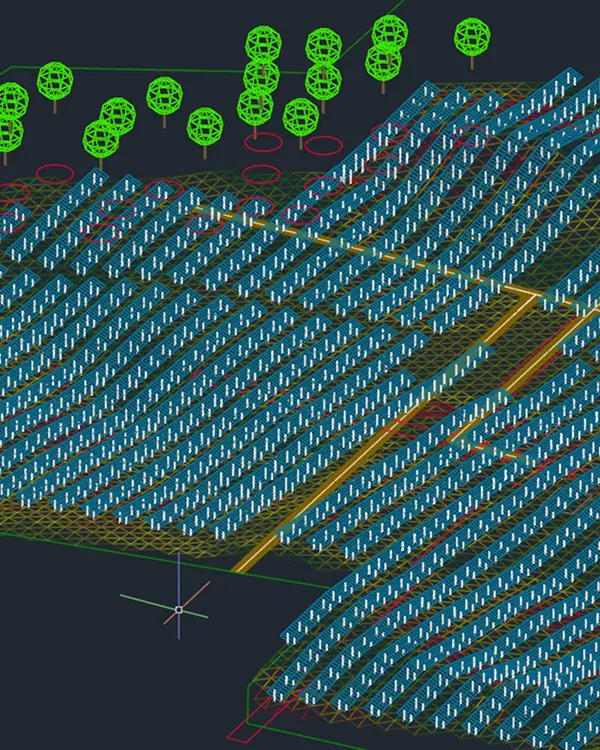
Solar system design software empowers developers and engineers to design solar projects faster, smarter, and more precisely. By optimizing solar production and maximizing yield, specialized solar design tools help teams deliver more efficient and profitable solar solutions.
Whether used for smaller commercial and industrial systems or utility-scale solar projects, the right solar software platform automates tasks that once took hours of manual labor, cutting project design time by up to 90%.
The advantages offered by specialized PV design software warrant its use. Benefits include:
-
Accelerated project timelines through automated design flows and minimized work.
-
Improved design accuracy, enabled by advanced modeling tools that minimize errors and delays later in development.
-
Enhanced collaboration, allowing separate teams to work in lockstep within a single environment.
-
Greater financial potential, from the selection of high-potential sites to enhanced yield optimization.
-
Scalable workflow management across single or multiple projects with finely replicable standards and processes.
Key features of professional solar design software
Today’s specialized solar design solutions combine advanced automation, accuracy, and simulation to strengthen every stage of the planning process and deliver the best possible outcomes. Core capabilities include:
3D modeling & visualization
High-fidelity 3D modeling and visualization solutions simulate real-world conditions to an exacting standard, with multiple data layers that allow for the integration of terrain data, structural interactions, environmental elements, and more.
Electrical engineering for secure grid interconnection
Modern software for solar design must feature automated electrical engineering to generate Single-Line Diagrams (SLD) and optimize DC/AC collection systems. This ensures grid compliance and minimizes voltage drop losses.
Automated design & layout optimization
Centimeter-level terrain adaptation for any site, instant alternate layout testing, and automated cable routing for wider infrastructure integration. Taken together, these solar system design tools eliminate manual errors and offer faster project delivery.
Advanced shading & yield simulation
Solar energy design software takes the guesswork out of project development. Engineers and developers can identify energy losses from shading, terrain, and structure design, run numerous simulations in moments, and adapt accordingly.
Benefits of using solar design software
90% faster design
Advanced automation of ground-mounted and rooftop solar systems dramatically reduces development timelines. Fully integrated solar system design software allows engineers to generate layouts, run simulations, and refine designs in a fraction of the time compared to manual CAD workflows.
Reduced data risk and human error
Centralized project data eliminates fragmented workflows and version conflicts. With shared datasets and built-in validation checks, teams maintain a single source of truth across all development stages.
Better resource utilization and cost optimization
By automating repetitive engineering tasks, teams can focus on optimization and strategic decision-making. This leads to improved material efficiency, reduced rework, and stronger project margins.
In one case, 30% of engineering time was reallocated to value-added tasks.
Higher customer confidence and proposal success
Accurate designs and precise energy projections strengthen investor trust and improve proposal win rates. Faster turnaround times provide a clear competitive advantage in a growing solar market.
Types of solar design solutions by market segment
Utility-scale solar plant design software
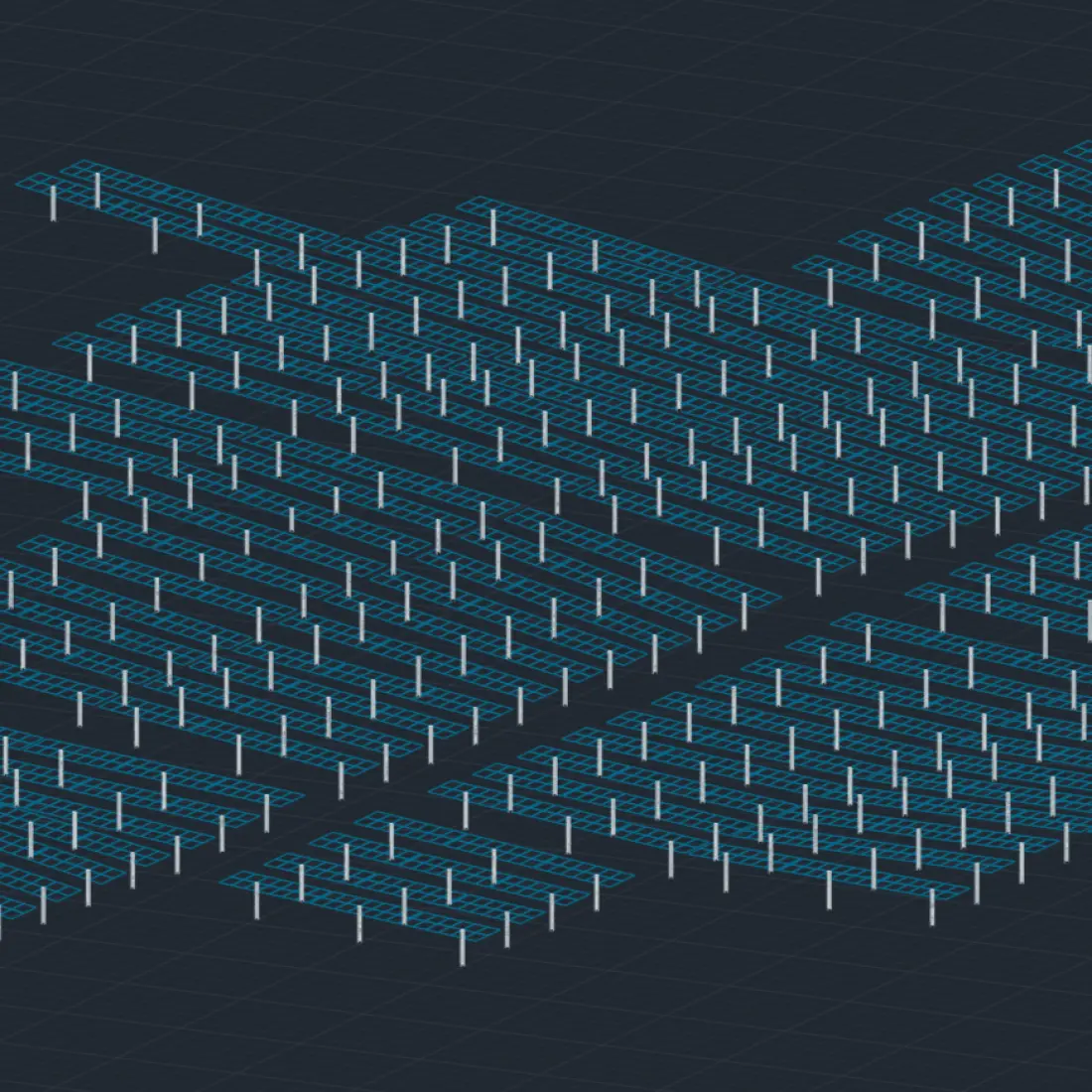
Utility-scale project development necessitates the management of vast land areas, often over variably complex terrain profiles, and integrated into regionally distinct grid networks.
Without PV solar design software capable of automating terrain-adaptive layout generation, voltage drop calculations, and yield simulations, projects of this magnitude wouldn't be viable.
Solar farm design software also helps keep the red tape in check by automatically generating compliant designs and complete reports whenever needed.
Commercial & industrial rooftop solar system design
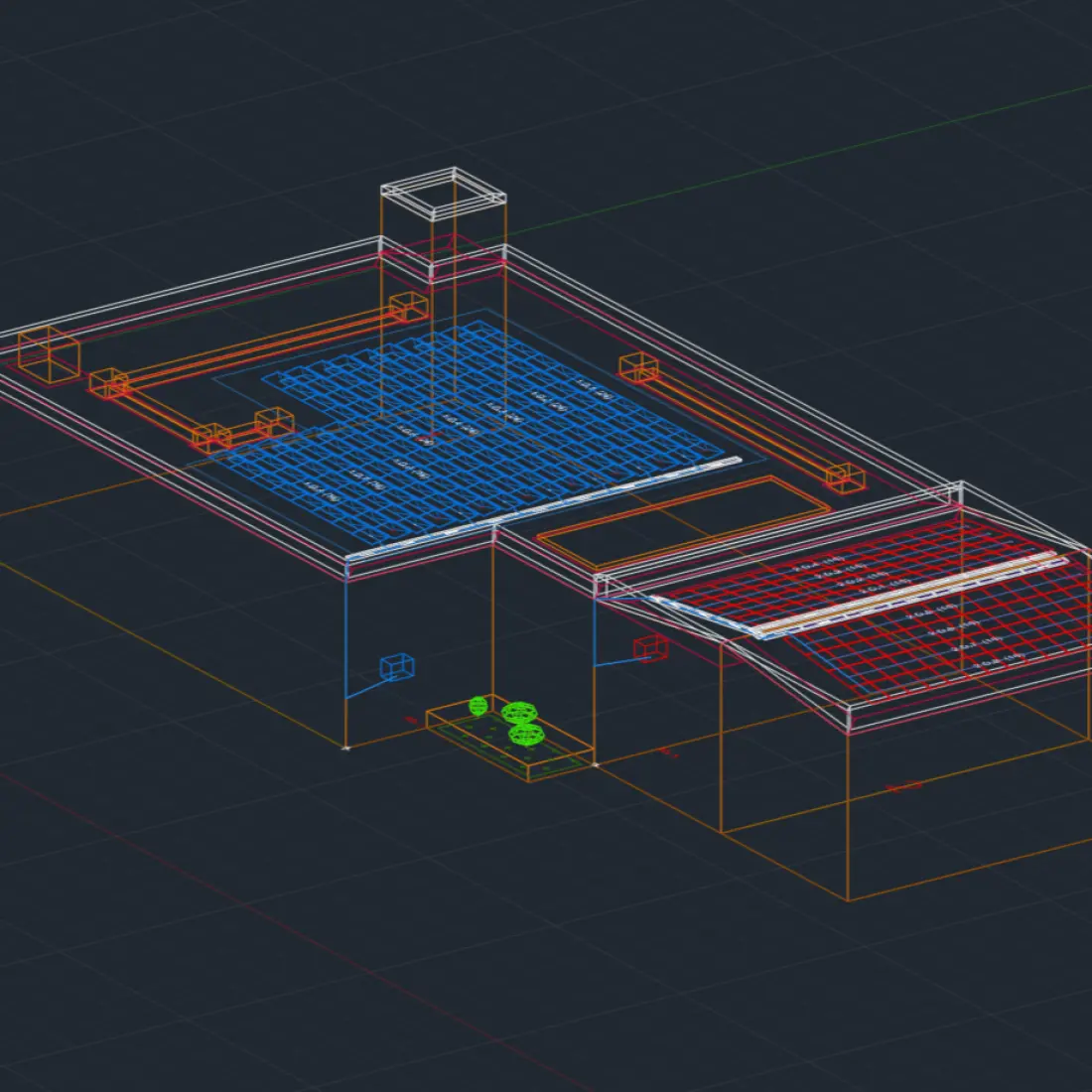
C&I rooftop project solutions allow for accurate modeling, regardless of roof complexity or tight spatial constraints, using a range of inputs, including architectural blueprints, drone survey data, and satellite imagery, thereby creating models as close to reality as possible.
Immediate energy yield simulations, and precise visual renderings enable sales engineers to offer enticing project bids to clients and empower designers to deliver on those promises.
Essential solar design software & complementary tools
Professional end-to-end solar PV design software unifies processes for utility-scale projects that are traditionally handled separately – from GIS analysis to design and project management. Additionally, energy yield simulation, usually handled with a different dedicated tool, can also be integrated seamlessly into this workflow.
Below is an overview of specialized tools that blend easily into your preferred solar software:
 \
Site selection & analysis tools \
\
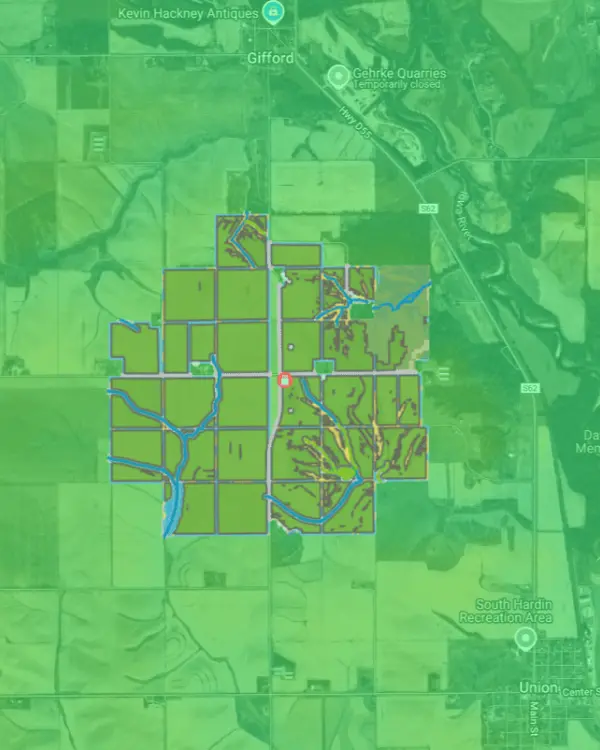
The foundation of every successful utility-scale solar project is optimal site selection. Optimal site selection must leverage high-resolution buildable area analysis and climate-adjusted flood risk data to mitigate construction hazards, as well as ISO-aligned power flow modeling to ensure interconnection. Furthermore, by integrating historical LMP pricing and IRA incentive layers, developers can identify viable points of interconnection while eliminating non-viable sites early.
\
Site selection & analysis tools \
\
The foundation of every successful utility-scale solar project is optimal site selection. Optimal site selection must leverage high-resolution buildable area analysis and climate-adjusted flood risk data to mitigate construction hazards, as well as ISO-aligned power flow modeling to ensure interconnection. Furthermore, by integrating historical LMP pricing and IRA incentive layers, developers can identify viable points of interconnection while eliminating non-viable sites early.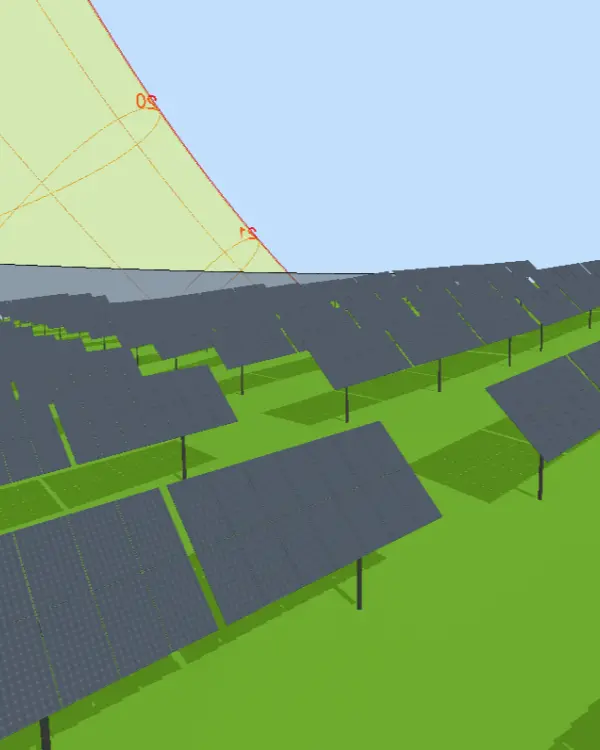 \
Energy yield simulation & design optimization \
\
Energy output simulations show the true potential of a project over its lifetime. Accurate yield modeling software utilizes detailed 3D modeling, physics-driven simulations, and weather forecasting to deliver precise estimates, inclusive of site and technology selection. Advances in cloud computing and machine learning allow for multiple scenarios to be run in parallel, turning hundreds of man-hours of manual work into a few button clicks.
\
Energy yield simulation & design optimization \
\
Energy output simulations show the true potential of a project over its lifetime. Accurate yield modeling software utilizes detailed 3D modeling, physics-driven simulations, and weather forecasting to deliver precise estimates, inclusive of site and technology selection. Advances in cloud computing and machine learning allow for multiple scenarios to be run in parallel, turning hundreds of man-hours of manual work into a few button clicks. \
Project management & collaboration features \
\
Streamline project management across multi-disciplinary teams, geographies, and development stages within a single platform. Automated data transitions between GIS and CAD environments ensure zero-loss data integrity, accelerating the shift from preliminary due diligence to detailed engineering. By standardizing workflows and tracking site control status in real-time, developers can reduce soft costs and ensure total stakeholder alignment across the entire project lifecycle.
\
Project management & collaboration features \
\
Streamline project management across multi-disciplinary teams, geographies, and development stages within a single platform. Automated data transitions between GIS and CAD environments ensure zero-loss data integrity, accelerating the shift from preliminary due diligence to detailed engineering. By standardizing workflows and tracking site control status in real-time, developers can reduce soft costs and ensure total stakeholder alignment across the entire project lifecycle.
Trusted by industry leaders








How integrated solar design solutions transform project development
Solar system design software has reshaped the way we approach renewable energy planning and development.
The process has evolved beyond individual, siloed workflows and toward a fully integrated ecosystem; one that prioritizes end-to-end solutions, streamlined integration, and data security.
From site selection to construction-ready designs
Traditionally, the path from early feasibility to build-ready design has been reliant upon fragmented processes, manual CAD work, and time-consuming revision cycles.
Solar PV system design software automates laborious design processes and minimizes the need for revisions with precise modeling and simulation. When integrated into a broader solar project development platform, this enables stakeholders to:
-
Evaluate more potential sites.
-
Spend more time on value-enrichment tasks.
-
Offer accurate long-term yield projections.
-
Scale improved workflows to grow project pipelines.
Streamlined workflow integration
Consolidating workflows across teams and ensuring optimal collaboration has long been a particular challenge of mid-to-large-scale solar power projects.
Modern solutions to asset management, version control, and real-time updating ensure standardization and project integrity, even over protracted workflows. They enable project managers to:
-
Connect site selection, engineering, and yield simulation workflows.
-
Regulate processes and standards across teams.
-
Minimize handoff errors and project lead times.
-
Share progress across external stakeholders with ease.
Data security and risk mitigation
Information security and data integrity can be jeopardized each time sensitive data needs to be shared between platforms.
By maintaining all information within a single encrypted environment, permission-based access can be controlled, potential vulnerabilities eliminated, and audit trails simplified. The advantages include:
-
Secure storage with role-based access and monitoring.
-
Clear version histories for transparency and compliance.
-
Comprehensive failsafes against data loss or corruption.
-
Integrated clash detection tools to eliminate data inconsistencies.
Choosing the right solar panel system design software
Scalability and integration capabilities
In fast-growing projects, solar panel system design software must be able to keep pace with the evolving demands of a project and accommodate an expansive range of cross-department workflows.
Scalability ensures a platform can handle increasingly complex datasets, detailed models, and concurrent simulations without performance degradation.
Look for:
-
Integrated solutions that offer modeling, simulation, and workflow tools within one platform for end-to-end operations.
-
Comprehensive environments that prioritize computational scalability for running simultaneous programs and real-time collaboration.
-
Support for a range of import and export formats for seamless integration into existing data environments.
Flexibility
From utility-scale to small-scale commercial projects, a design platform for a PV solar system should offer tailored solutions to meet specific needs.
Regardless of the size of the project, its location, or its hardware, the system performance has to be tested and optimized.
Look for:
-
Optimal terrain adaptability, including automatic layout generation and customization.
-
Flexible configurations to accommodate single-axis trackers, fixed-tilt systems, and other support systems.
-
Automated electrical design for optimal material usage, minimal cable losses, and efficient systems.
Global regulatory & engineering compliance
To navigate the complexities of evolving regional grid regulations and building codes, developers must utilize ISO-aligned engineering platforms capable of delivering compliant-ready solutions across varied jurisdictions.
Look for:
-
High-resolution exports for land-use, impact surveys to streamline agency approvals.
-
Compliance with national regulations utilizing validated capacity modeling that accounts for cluster study dynamics and N-1 contingencies.
-
Secure information controls conforming to GDPR and ISO 27001 standards for localized data protection and cybersecurity.
-
Restriction assessment tools that integrate hundreds of data layers—including topography, critical habitats, and infrastructure buffers—to delineate buildable acreage with precision.
PVcase: Leading solar design software platform
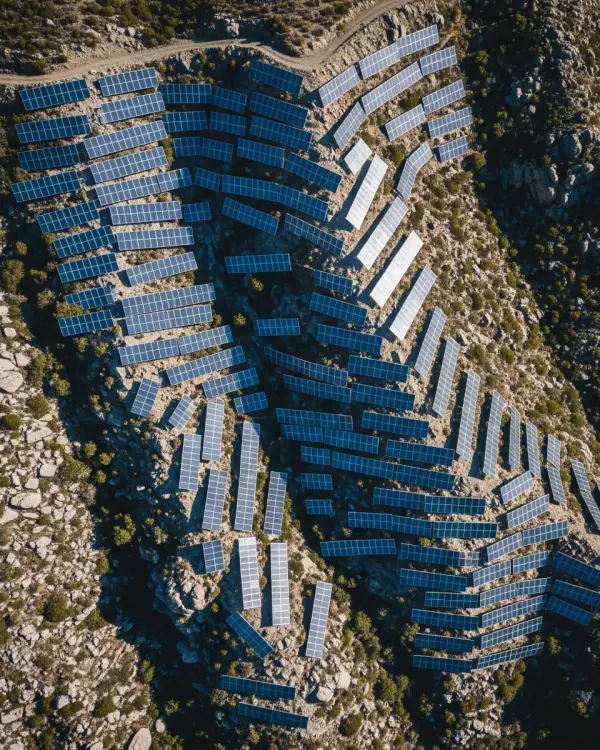
PVcase replaces fragmented solar workflows with a unified, topographically aware engineering ecosystem. By tethering PVcase Ground Mount’s automated electrical design and terrain-following capabilities directly to Prospect’s geolocated restriction layers, developers eliminate data corruption at the source. This bidirectional flow continues into PVcase Yield, where ray-tracing simulations validate sub-hourly performance against real-world shading and slope constraints. Engineers move from site selection to high-fidelity layouts in minutes, de-risking the project pipeline through unmatched technical rigor.
 \
Platform overview \
\
Designed to replace fragmented workflows with a holistic solution, PVcase enables teams to move from land screening to design and yield optimization within a single platform. \
Each stage of development is made faster and smarter with logical automation, advanced modeling, and precise simulation capabilities.
\
Platform overview \
\
Designed to replace fragmented workflows with a holistic solution, PVcase enables teams to move from land screening to design and yield optimization within a single platform. \
Each stage of development is made faster and smarter with logical automation, advanced modeling, and precise simulation capabilities.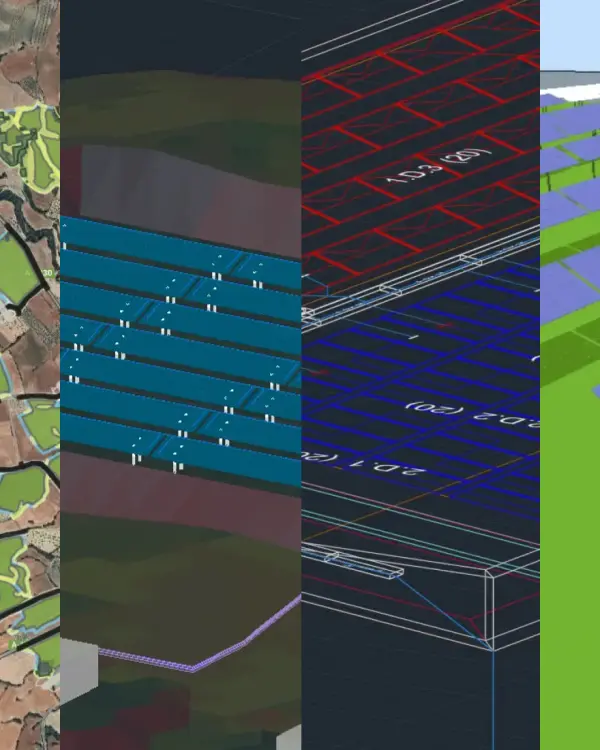 \
Trusted by 1,800+ companies in 80+ countries \
\
With more than 4TW of capacity supported annually, PVcase has helped bring solar projects into the light in over 80 countries for more than 1800 customers. Every package is tailored to suit the specific needs of each client, and successful projects range from utility-scale solar plants to commercial and industrial rooftops. Read our real-world success stories here.
\
Trusted by 1,800+ companies in 80+ countries \
\
With more than 4TW of capacity supported annually, PVcase has helped bring solar projects into the light in over 80 countries for more than 1800 customers. Every package is tailored to suit the specific needs of each client, and successful projects range from utility-scale solar plants to commercial and industrial rooftops. Read our real-world success stories here.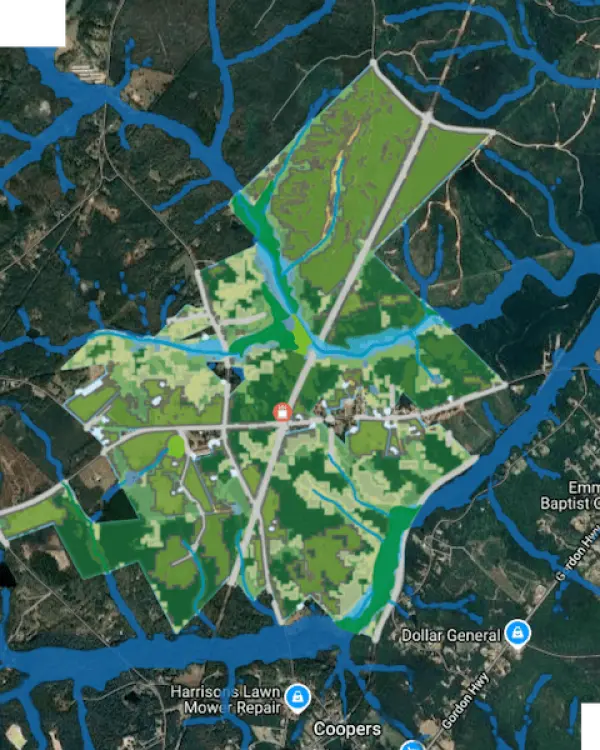 \
Site selection with prospect \
\
PVcase Prospect is an all-in-one solution for early site selection and procurement for renewable energy projects and data centers. Cut market entry and labor with automated parcel search, ensure viability with access to comprehensive ISO-aligned power flow studies, and manage the entire process - from evaluation to permitting and preliminary layout - in one environment.
\
Site selection with prospect \
\
PVcase Prospect is an all-in-one solution for early site selection and procurement for renewable energy projects and data centers. Cut market entry and labor with automated parcel search, ensure viability with access to comprehensive ISO-aligned power flow studies, and manage the entire process - from evaluation to permitting and preliminary layout - in one environment.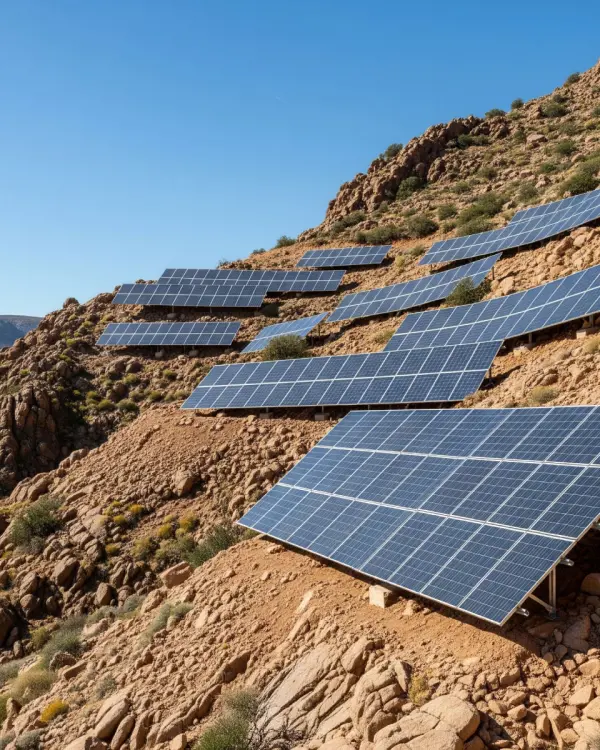 \
Integration with AutoCAD and engineering workflows \
\
Our AutoCAD-driven solution embeds solar-specific logic — including terrain-following topography adaptation and automated electrical stringing — and maintains CAD’s flexibility while eliminating the manual errors typical of disconnected workflows. The result is a high-precision system that generates accurate Bill of Materials (BoM) and 8760 energy files directly from your layout.
\
Integration with AutoCAD and engineering workflows \
\
Our AutoCAD-driven solution embeds solar-specific logic — including terrain-following topography adaptation and automated electrical stringing — and maintains CAD’s flexibility while eliminating the manual errors typical of disconnected workflows. The result is a high-precision system that generates accurate Bill of Materials (BoM) and 8760 energy files directly from your layout.
80%
decrease in design time
<5mins
to analyze site
3x
more layouts in one day
Pipeline impact of solar design software
We empower teams to de-risk their entire pipeline, reducing the timeline for fully completed case projects from five months to just one. PVcase ends "clunky" processes and corrupted data by unifying site selection, design, and yield estimation into a single digital thread. This integrated approach drives informed decision-making and better financial outcomes, transforming site evaluation from expensive guesswork into a scalable, data-driven success.
Solar that sees the light of day
Solar design software FAQs
What is professional solar design software used for?
Professional solar design software is used to automate and optimize the design of photovoltaic systems across utility-scale and commercial projects. It supports terrain-responsive layout creation, cable routing, shading analysis, and integrated energy yield simulations.
By replacing manual CAD workflows with automated modeling tools, solar design platforms streamline project development from feasibility through construction-ready documentation. This allows engineering and EPC teams to design faster, evaluate multiple scenarios, and reduce project risk.
How does solar design software accelerate project development?
Solar design software accelerates development by automating layout generation, terrain adaptation, and performance simulations. Engineers can generate and refine layouts, run yield analyses, and compare design iterations in significantly less time than traditional drafting methods.
Automated comparisons and centralized datasets reduce repetitive tasks and eliminate delays caused by manual revisions, helping teams meet tight proposal deadlines and move projects into construction faster.
What key features define modern solar design software?
Modern solar design software includes automated terrain adaptation, intelligent cable routing, advanced shading analysis, and integrated energy yield modeling. These features eliminate slow manual processes while improving layout precision.
Strong platforms also provide centralized data management and version control, ensuring alignment between development, engineering, and EPC teams. Construction-ready documentation and scalable project handling are essential capabilities for utility-scale deployments.
How does solar design software reduce human error and data risk?
Solar design software reduces human error by centralizing project data and automating calculations across layouts, simulations, and documentation. This eliminates fragmented workflows and version conflicts commonly associated with manual processes.
With a single source of truth, teams can maintain consistency between proposal designs and final construction documents, strengthening data integrity and minimizing project risk from development through execution.
How do shading analysis and yield simulation improve solar project performance?
Shading analysis evaluates how terrain and surrounding objects affect system output, while yield simulation calculates expected energy production based on layout configuration and environmental conditions.
Together, these tools enable more accurate energy projections, optimized system design, and stronger financial modeling. Accurate performance forecasting improves investor confidence and increases proposal competitiveness.
What is the difference between solar site selection and solar layout design?
Solar site selection focuses on identifying viable land or rooftop locations based on environmental constraints, grid proximity, and regulatory considerations.
Solar layout design begins after feasibility is confirmed and involves configuring panel placement, optimizing cable routing, adapting to terrain, and modeling system performance. Site selection determines viability, while layout design transforms a feasible site into a detailed, construction-ready project.
Is solar design software suitable for utility-scale solar projects?
Yes. Solar design software is built to support the complexity of utility-scale developments, including large datasets, terrain modeling, and multi-megawatt layout optimization.
Automation and integrated modeling allow engineering teams to manage extensive portfolios efficiently while maintaining design accuracy and performance reliability across project stages.
How does solar design software improve proposal win rates?
Accurate layouts and realistic energy yield projections strengthen investor trust and improve proposal success rates. Faster design cycles allow developers to respond quickly to RFP requirements and refine project economics.
By delivering data-backed projections and construction-ready documentation, solar design software reduces uncertainty and provides a competitive advantage in rapidly growing solar markets.
 \
\
Blog\
\
Virto CAD vs. PVcase Ground Mount: a technical comparison \
\
April 9, 2026\
\
PVcase Products
\
\
Blog\
\
Virto CAD vs. PVcase Ground Mount: a technical comparison \
\
April 9, 2026\
\
PVcase Products  \
\
Blog\
\
Solar design software comparison: PVcase and Helios3D \
\
August 11, 2026\
\
PVcase Products
\
\
Blog\
\
Solar design software comparison: PVcase and Helios3D \
\
August 11, 2026\
\
PVcase Products  \
\
Webinars\
\
Achieving technical autonomy and speed in PVcase Ground Mount solar design \
\
May 12, 2026
\
\
Webinars\
\
Achieving technical autonomy and speed in PVcase Ground Mount solar design \
\
May 12, 2026
© 2026 PVcase
PRODUCT
SOLUTIONS
COMPARE
APPLICATIONS
RESOURCES
PRICING
COMPANY
© 2026 PVcase