%22%20style%3D%22fill%3A%20rgb(5%2C%205%2C%205)%20!important%3B%22%3E%3Cpath%20d%3D%22M132.476%206.733h10.665V3.165h-15.008v15.614h15.008V15.21h-10.665v-2.495h9.834V9.148h-9.834V6.733m-12.78%2012.046H109.12V15.21h11.327v-2.406h-6.604c-3.302%200-5.111-1.647-5.111-4.658v-.315c0-3.011%201.809-4.658%205.111-4.658h9.744V6.74h-10.503v2.406h6.604c3.302%200%205.11%201.647%205.11%204.658v.315c0%203.012-1.808%204.659-5.11%204.659m-31.842%200h4.643l1.364-3.633h7.428l1.316%203.633h4.617l-5.933-15.614h-7.34l-6.087%2015.614zm10.35-12.046%201.76%204.844h-4.77l1.808-4.844zM86.62%208.945v.622h-4.351V6.733h-9.39v8.477h9.39v-2.745h4.351v.533c0%203.86-1.921%205.78-5.796%205.78h-6.491c-3.884%200-5.797-1.92-5.797-5.78v-4.06c0-3.86%201.921-5.781%205.797-5.781h6.515c3.859%200%205.78%201.921%205.78%205.78M61.971%2018.78%2067.3%203.165h-4.53L58.799%2015.21h-1.251L53.575%203.165h-4.618l5.328%2015.614h7.686M35.967%206.733h7.201v3.149h-7.201zM31.615%2018.78h4.352V13.45h6.442c3.302%200%205.11-1.647%205.11-4.658v-.96c0-3.012-1.808-4.66-5.11-4.66H31.615v15.615zM10.358%207.298h1.292V6.007h-1.292zm1.13-4.069h-.976v.977h.976zM11.335.452h-.662v.662h.662zm1.453%204.07h-.977v.976h.977zm-.161-2.778h-.662v.67h.662zM5.999%209.058H7.29V7.767H6zm-.356-2.793H4.505v1.138h1.138zM3.98%204.771h-.977v.977h.977zM2.325%203.27h-.823v.823h.823zM.67%201.768H0v.67h.67zm7.097%205.53h1.291V6.007H7.767zm-.364-2.793H6.265v1.138h1.138zM5.748%203.003h-.977v.977h.977zM4.093%201.502H3.27v.823h.823zM2.438%200h-.67v.662h.67zm6.62%208.59h1.292V7.298H9.058zm1.139-4.069H9.22v.977h.977zm-.154-2.777h-.67v.67h.67zM6%2011.65H7.29v-1.292H6zm-2.77-.162h.977v-.976H3.23zm-2.777-.153h.662v-.662H.452zM8.59%209.058H7.298v1.292H8.59zm-3.092.162h-.977v.977h.977zm-3.084.153h-.67v.662h.67zm2.107%203.415h.977v-.977h-.977zm-2.777-.161h.67v-.662h-.67zM22%200h-2.729l-6.33%206.33v.968H11.65V8.59h1.768v4.828H8.59V11.65H7.298v1.292H6.33L0%2019.272V22h2.729l6.33-6.33V22h3.883v-6.33l6.33%206.33H22v-2.729l-6.33-6.33H22V9.059h-6.33L22%202.728z%22%20style%3D%22fill%3A%20rgb(5%2C%205%2C%205)%20!important%3B%22%2F%3E%3C%2Fg%3E%3Cdefs%20style%3D%22fill%3A%20none%20!important%3B%22%3E%3CclipPath%20id%3D%22a%22%20style%3D%22fill%3A%20none%20!important%3B%22%3E%3Cpath%20fill%3D%22%23fff%22%20d%3D%22M0%200h143.133v22H0z%22%20style%3D%22fill%3A%20rgb(255%2C%20255%2C%20255)%20!important%3B%22%2F%3E%3C%2FclipPath%3E%3C%2Fdefs%3E%3C%2Fsvg%3E)
LandGate vs. PVcase Prospect: Technical Comparison for Data Center Interconnection
The article provides a detailed technical comparison between LandGate and PVcase Prospect for data center interconnection site selection, highlighting PVcase Prospect’s superior engineering-grade data capabilities such as system-wide power flow studies, extensive pricing nodes, bulk parcel screening, and detailed fiber infrastructure status, which collectively offer a definitive advantage in avoiding costly project delays.

LandGate vs. PVcase Prospect: a technical comparison for data center interconnection
Why engineering-grade data wins the power-first site selection race

Max HailerContent project manager
February 9, 2026
PVcase Products
Executive summary:
In the race for power, relying on any data center site selection software can easily lead to multi-million dollar delays. The key differentiator? Engineering-grade data. This blog post offers a detailed comparison of LandGate vs. PVcase Prospect, explaining in detail why system-wide power flow studies provide the definitive advantage for data center interconnection.
LandGate vs. PVcase Prospect differences at a glance
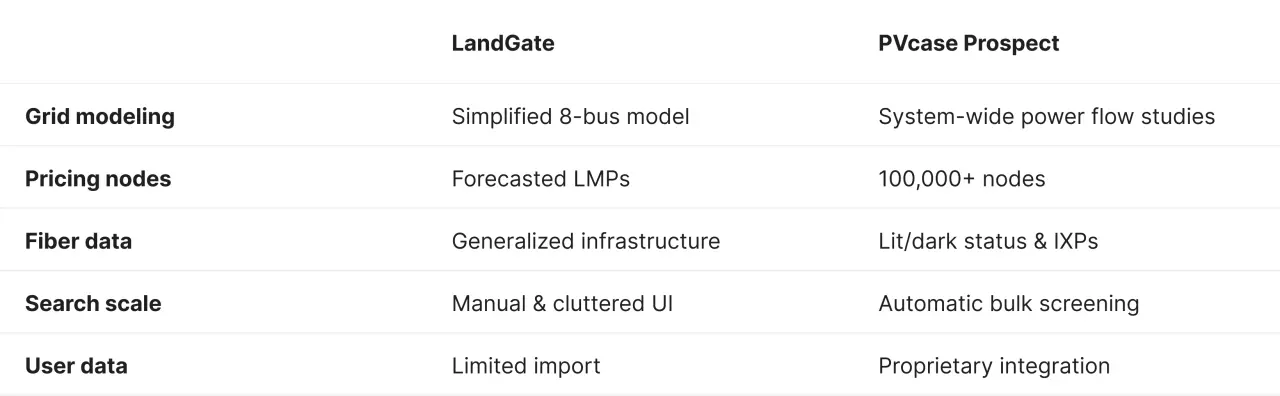
Technical Comparison: Why leading data center developers choose PVcase Prospect’s system-wide engineering data over simplified theoretical models to de-risk interconnection and infrastructure due diligence.
Table of contents
- Why system-wide power flow studies are crucial to navigate the interconnection queue
- Why power flow studies are crucial to navigate the interconnection queue
- Why you need to look beyond proximity to a line
- How node density affects LMPs and grid offtake capacity economics
- How to correctly map critical fiber optic infrastructure and utilities
- How to solve the greenfield bottleneck in data center site selection
- Why user data integration is critical for data center de-risking
- How to navigate local hurdles using data center community sentiment data
- Conclusion
Why system-wide power flow studies are crucial to navigate the interconnection queue
When developing data centers, power comes first: securing a firm power commitment is the most significant bottleneck for any hyperscale facility. Developers often enter land agreements only to discover the local substation cannot handle the load without prohibitive upgrades.
The risks of LandGate’s 8-Bus modeling
-
Simplified abstraction: Offers a limited view of the grid through a theoretical teaching model, ignoring limiting grid issues beyond the nearest 8 buses to a POI.
-
Negated N-1 Impacts: The limited scope of the N-1 studies negates all impact outside the 8 buses, leading to go/no-go decisions that are based on incomplete numbers.
-
ISO blindness (ERIS/NRIS): As the ERIS and NRIS scenarios are restricted by the same lack of system-wide visibility, the modeling cannot predict the specific inclusion rules used by ISOs like PJM or MISO.
The PVcase Prospect solution: system-wide power flow studies
-
Holistic grid overview: Provides power flow studies that cover the entire system, flagging potential offtake limitations and upgrade cost spikes due to issues elsewhere in the network.
-
Comprehensive N-1 & ERIS/NRIS: Evaluates interconnection scenarios across the full grid, ensuring that "sweet spots" are identified based on the total network's behavior.
-
CEII-verified data: Utilizes restricted data to simulate grid behavior under stress, providing accurate grid offtake capacity values.
Discover how to identify quality grid offtake capacity data in our deep dives.
PRO TIP
Ask your provider, " Does your grid capacity modeling account for N-1 contingency analysis, thermal constraints, or specific operator inclusion rules?"
Why you need to look beyond proximity to a line
Selecting a site based only on proximity to a Point of Interconnection (POI) often leads to "sticker shock" when the utility returns its formal study.
How LandGate misses the transmission line reality
-
Partial grid visibility: Lacks modeling for transmission line capacity, focusing primarily on substations.
-
Electrical blockage: Risks of selecting a POI that is electrically constrained further upstream.
-
Reactive budgeting: Can lead to project abandonment when upgrade costs balloon late in the development cycle.
The PVcase Prospect solution: granular upgrade cost forecasting
-
Financial transparency: Provides detailed reports with projected cost breakdowns for necessary network upgrades.
-
Automated risk screening: Identifies if a million-dollar transformer upgrade is lurking in your future before you sign a lease.
-
Proactive siting: Allows developers to move POIs downstream or shift timing to match planned utility upgrades.
PRO TIP
Ask your provider, " Can you provide a detailed breakdown of a POI’s transmission line capacity?"
How node density affects LMPs and grid offtake capacity economics
Finding the right POI isn’t just a matter of securing enough power. A site with cheap land is irrelevant if the electrical pricing node is economically unfavorable. The 'hidden' costs of chronic congestion or high basis risk at a distant node can lead to unexpected revenue erosion that far outweighs any initial savings on parcel acquisition.
LandGate’s speculative pricing economics
-
Node scarcity: Tracks fewer nodes than the industry standard, leading to imprecise pricing evaluations.
-
Forecasted uncertainty: Relies on speculative forecasted LMPs, which lack a standard "science" for long-term accuracy.
-
Basis Risk Exposure: Using the wrong node results in fundamentally flawed ROI assessments and financial blind spots.
The PVcase Prospect Solution: 100,000+ nodes for precision Basis Analysis
-
Unmatched coverage: Tracks over 100,000 nodes via Yes Energy to ensure the most accurate pricing data for every POI.
-
Closest electrical match: Guarantees you are analyzing the specific node that will govern your project's economics.
-
Risk mitigation: Enables precise basis risk calculations to protect the long-term profitability of your data center asset.
PRO TIP
Ask your provider, " How many unique pricing nodes do you track?"

How to correctly map critical fiber optic infrastructure and utilities
Data centers require a trifecta of power, water, and fiber. Without precise route certainty, the cost of bringing "dark fiber" to a site can flip a project from profitable to stagnant.
LandGate’s risks of generalized infrastructure mapping
-
Engineering gap: The lack of a dedicated transmission engineer on staff prevents deep technical validation of infrastructure data.
-
Generalized maps: Relies on generalized infrastructure layers and static PDF maps that lack the resolution for mission-critical site selection.
The PVcase Prospect solution: redundant path and latency verification
-
Technical fidelity: Provides non-public fiber route data—including IXP s and lit/dark status—for redundant path verification.
-
Performance analysis: Supports latency analysis by mapping verified fiber paths alongside wastewater and pipeline locations.
-
Physics-based siting: Connects site selection to technical reality, ensuring connectivity strategies are grounded in verified infrastructure.
Find out why fiber data access is non-negotiable for data centers in our recent deep dive.
PRO TIP
Ask your provider, " Is your infrastructure data validated against CEII-protected planning data?"
How to solve the greenfield bottleneck in data center site selection
Manually sifting through thousands of parcels is a slow, error-prone process that costs teams their first-mover advantage.
LandGate’s manual search inefficiency
-
Unsegmented UI: Presents numerous input fields simultaneously, creating a cluttered experience for large-scale searches.
-
Search resolution gaps: Lacks the automated resolution needed to handle massive greenfield land analysis effectively.
-
Limited automation: Requires significant manual effort to sift through results, slowing down the development cycle.
The PVcase Prospect solution: high-scale bulk parcel analysis
-
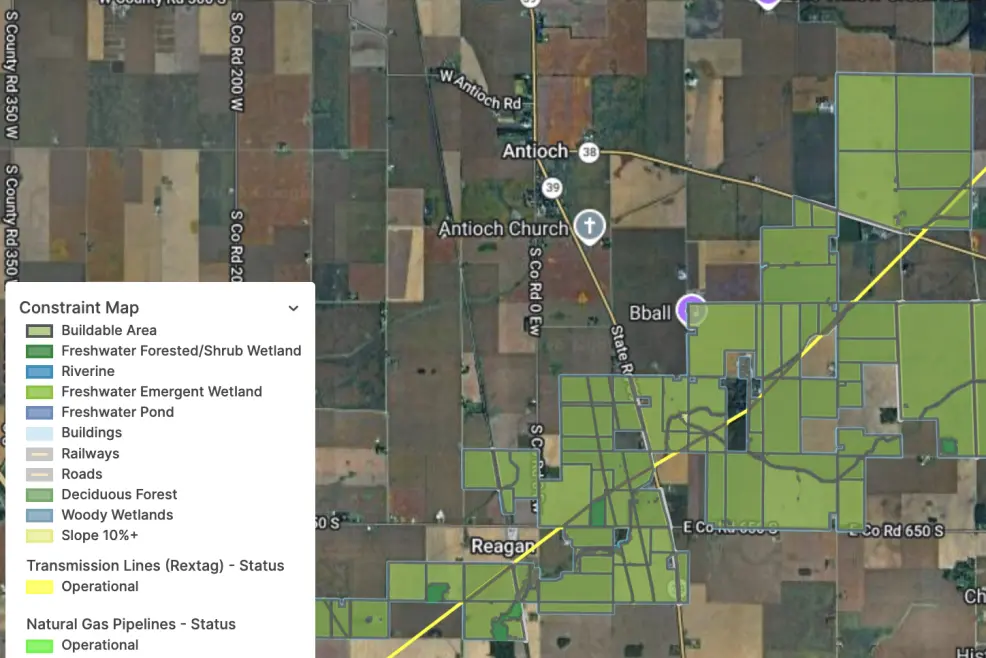
Rapid screening: Enables users to screen thousands of parcels in minutes using intuitive, automated constraint maps.
-
Strategy-first workflow: Automates heavy data lifting, allowing teams to focus on strategy rather than manual sifting.
-
Multi-regional reach: Supports massive searches across entire ISO regions to identify viable areas before engaging landowners.
PRO TIP
Ask your provider, " Does your platform support the automated analysis of several parcels simultaneously?"
Why user data integration is critical for data center de-risking
Integrating proprietary GIS layers with public grid information eliminates the risk of "corrupted data" and human error caused by jumping between fragmented tools and static maps. It also allows developers to validate physical constraints against power flow models, producing defensible documentation to prove a site’s long-term viability.
Proprietary data silos in LandGate’s software
-
Integration friction: Users find it difficult or impossible to bring their own datasets into the platform for analysis.
-
Workflow fragmentation: Forces teams to jump between multiple tools, increasing the risk of missing technical conflicts.
-
Incomplete context: Limits the ability to perform a holistic buildable area analysis based on company-specific criteria.
The PVcase Prospect solution: Open user data integration
-
Holistic analysis: Facilitates the easy import of GIS files and proprietary datasets for centralizing buildable area analysis.
-
Standardized workflow: Ensures site selection reflects the full picture of specific technical and commercial requirements.
-
Single source of truth: Integrates public, premium, and user-specific data into one cloud-based decision-making platform.
PRO TIP
Ask your provider, " How can I import my own GIS layers and proprietary datasets within your platform?"

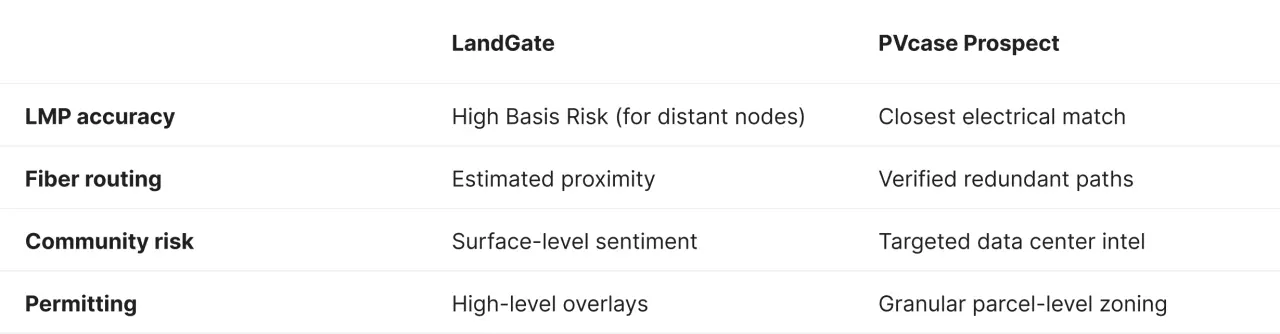
How to navigate local hurdles using data center community sentiment data
The impact of community sentiment on data centers is not to be ignored: $64 billion of projects have been blocked or delayed in the US alone.
LandGate: surface-level permitting resolution
-
Broad overlays: Primarily offers high-level overlays rather than deep, parcel-level analysis.
-
Late-stage discovery: Lacks the resolution to identify specific local AHJ or environmental permitting hurdles early in the cycle.
-
Generic sentiment: Offers general real estate sentiment that may not capture specific risks associated with data centers.
The PVcase Prospect solution: data center community sentiment and zoning
-
Targeted intelligence: Provides dedicated tools for data center community sentiment to proactively manage local opposition.
-
Parcel-level precision: Offers granular zoning analysis and environmental permitting data to identify red flags before they become obstacles.
-
Investor confidence: Protects timelines by identifying favorable local jurisdictions for mission-critical infrastructure.
PRO TIP
Ask your provider, " Does your community sentiment analysis specifically target data center development risks?"
Conclusion
In a market where power, fiber, and community acceptance define a project's success, relying on simplified models is a multi-million dollar risk. PVcase Prospect eliminates this uncertainty by providing engineering-grade, ISO-aligned power flow studies and precise infrastructure data to ensure your data center moves from site selection to interconnection with technical and financial certainty.
To see how these capabilities translate to real-world siting, explore our case study on early data center development with PVcase Prospect: a step-by-step breakdown of the platform's workflow evaluating grid capacity, parcel buildability, infrastructure access, and local zoning risks for a 200 MW project in Columbus, Ohio.

See it for yourself
Dive deeper and discover why PVcase Prospect is the standard for data center site feasibility.
Secure viable data center sites
 \
\
Blog\
\
PVcase Prospect vs. Paces: a technical benchmark \
\
June 30, 2026\
\
PVcase Products
\
\
Blog\
\
PVcase Prospect vs. Paces: a technical benchmark \
\
June 30, 2026\
\
PVcase Products 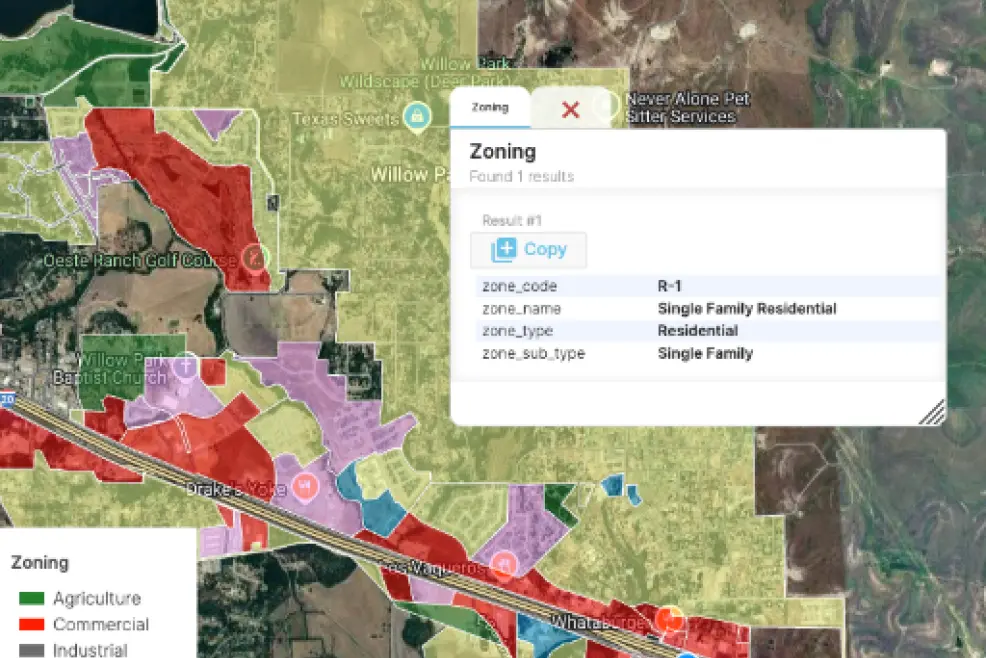 \
\
Blog\
\
Unlock PVcase Prospect's full potential: 10 must-know features for solar developers \
\
June 2, 2025\
\
PVcase Products
\
\
Blog\
\
Unlock PVcase Prospect's full potential: 10 must-know features for solar developers \
\
June 2, 2025\
\
PVcase Products  \
\
Blog\
\
Why do GIS tools like ArcGIS/QGIS hold back your solar projects? \
\
September 10, 2024\
\
Industry TrendsPVcase Products
\
\
Blog\
\
Why do GIS tools like ArcGIS/QGIS hold back your solar projects? \
\
September 10, 2024\
\
Industry TrendsPVcase Products
Key takeaways
What are the advantages of using ISO-aligned power flow simulations over 8-bus models?
ISO-aligned power flow simulations utilize comprehensive CEII data and N-1 contingency logic to reflect the exact, worst-case evaluation standards used by grid operators.
In contrast, simplified 8-bus models offer only directional estimates that ignore regional planning rules and queue congestion, often leading to "false positive" capacity results and unforeseen upgrade costs.
Is proximity to a Point of Interconnection (POI) crucial for site selection?
Although important, it is insufficient because it ignores upstream electrical constraints and transmission line capacity that can trigger project-killing "sticker shock".
Relying on proximity alone often leads to reactive budgeting and project abandonment, whereas ISO-aligned modeling identifies hidden thermal overloads and necessary infrastructure upgrades before a lease is signed.
How can I correctly forecast a project's LMP?
By utilizing high-density node coverage to identify the pricing node electrically closest to your site, rather than relying on speculative long-term curves.
Analyzing geolocated historical data instead of broad market averages allows you to quantify recurring congestion patterns and mitigate basis risk before committing capital.
How can I correctly map fiber optic lines?
By integrating non-public metadata—including IXPs and lit/dark status—to perform latency analysis and optimize connectivity.
Additionally, use high-fidelity GIS data to execute redundant path verification, guaranteeing physically separate routes rather than relying on generalized overlays.
How can I speed up parcel search?
Replace manual sifting with automated, criteria-based engines that instantly highlight land matching your specific size, zoning, and proximity requirements.
You can accelerate this greenfield discovery by conducting upfront interconnection viability assessments for entire regions, narrowing thousands of candidates to a shortlist of technically suitable parcels in seconds.
Why is user data integration important for data center development?
Because it eliminates the risk of "corrupted data" and human error caused by jumping between fragmented tools and static maps.
This overlay allows developers to validate rigid physical constraints against ISO-aligned power flow models, producing the defensible documentation required to prove a site's long-term viability to investors.
How can I assess local community sentiment towards data centers?
By utilizing dedicated data center community sentiment analysis tools that identify specific regional risks and opposition patterns.
This targeted approach allows you to navigate local AHJ permitting and environmental hurdles early, ensuring you select jurisdictions favorable to mission-critical infrastructure before committing capital.
© 2026 PVcase
PRODUCT
SOLUTIONS
COMPARE
APPLICATIONS
RESOURCES
PRICING
COMPANY
© 2026 PVcase